
The Core Premise
Identity Group Theory begins from a simple observation:
individuals belong to multiple identity groups, and these memberships shape behavior.
Rather than a single unified self, the individual is understood as a composite of multiple identity-based selves, each linked to a specific group and its expectations.
The Individual
In IGT, the individual is not a single, stable entity, but a dynamic system of interacting identities.
Each person consists of:
- A reflexive Self
- Multiple Social Selves, each tied to an identity group
These selves compete for time, energy, and attention, forcing individuals to make constant trade-offs in everyday life.
Identity Narrative
Every identity group operates through a shared framework—an identity narrative—that defines what it means to belong.
[👉 Figure 1: Identity Narrative Components]
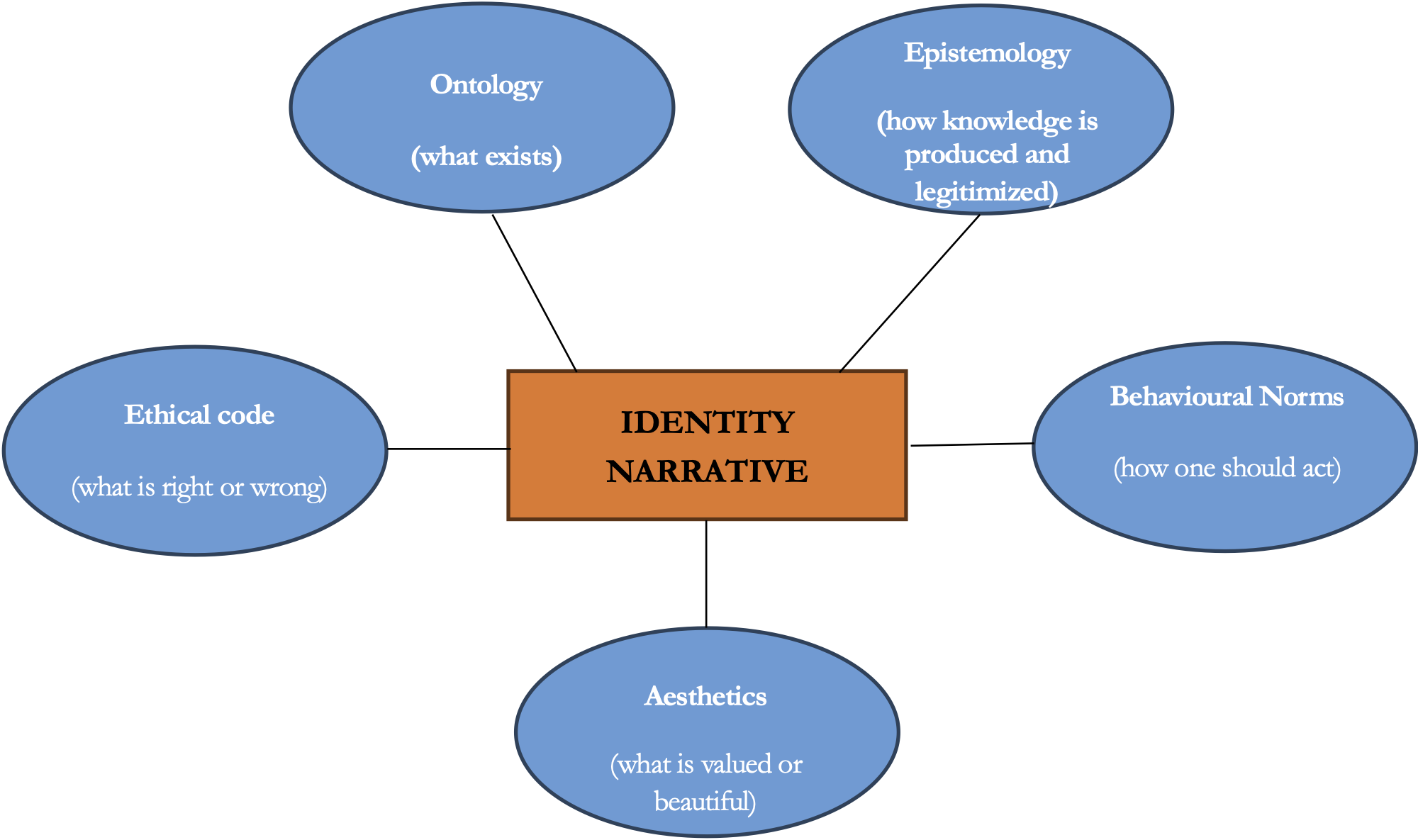
This includes:
- What is legitimate knowledge (epistemology)
- What exists (ontology)
- What is right (ethics)
- What is valued (aesthetics)
- How one should act (behavioral norms)
Identity Group Template
All identity groups share a common structure, consisting of three domains:
- Structural Characteristics
- Regulatory Mechanisms
- Identity Economies
This template allows IGT to analyse any identity group—from families to professions to nations—using a consistent framework.
Identity Economies
Identity is not only symbolic—it is also economic.
[👉 Figure 3: Identity Economies ]
Figure 2: Identity Economies – Vertical and Horizontal Resources
| Vertical resources | Horizontal Resources < – – – – – – – – – – – – – – – – – – – – – – – – – – – TIME – – – – – – – – – – – – – – – – – – – — – – – – – – > | |||
| Psychic Capital | Reciprocity Capital | Renown Capital | Monetary Capital | |
| < – – – – – – – – – – – – – – – – – – – – – – – – – – – ENERGY – – – – – – – – – – – – – – – – – – – – – – – – – – – > | ||||
Individuals allocate resources across identities, including:
- Monetary capital (money, material resources)
- Renown capital (status, recognition)
- Reciprocity capital (trust, obligation)
- Psychic capital (emotional and mental energy)
These are supported by finite horizontal resources:
time and energy.
Core Assumptions
IGT is built on five key assumptions:
- Individuals manage finite resources across identity groups
- Identity groups are structured, hierarchical, and economic
- Identity narratives shape behavior through norms and expectations
- Identity alignment depends on cost-benefit trade-offs
- Individuals act strategically within constraints
Key Concepts
- Interpellation: being “called into” an identity in interaction
- Salience: which identity dominates, based on resource allocation
- Identity narrative: the shared script of a group
- Capital: resources used to sustain identities